Methods By Which Suspension Measurement Systems Removes Guesswork within Suspension Tuning
Inside the intensely competitive world of modern serious drifting, podium finishes is no longer purely a product of sheer horsepower or behind-the-wheel bravado. Conversely, it has become a complex engineering challenge that necessitates a meticulous marriage of picking a inherently capable chassis, arming it with the most precise performance parts, and, most importantly, grasping its dynamic characteristics on the track through sophisticated drift telemetry software. This definitive guide acts as your master plan from the initial idea of a drift build right through to the last engineering-refined adjustments that elevate a strong vehicle into a repeatable winner. We will thoroughly explore the methodical process of car suspension tuning, showing how a modern vehicle dynamics tool like precise measurement hardware removes approximation and delivers exceptional insight into your vehicle's actual performance.
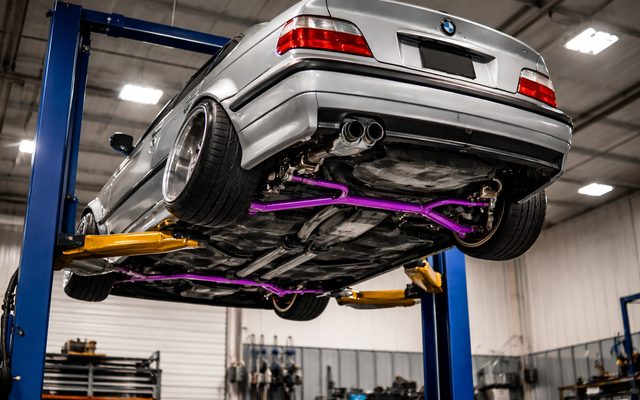
The cornerstone of any exceptional drift machine is, undoubtedly, the base vehicle itself. Several vehicles have attained renowned standing within the international oversteer culture due to their built-in handling characteristics, durable design, and the immense availability of aftermarket support available. Selecting the correct car is the primary and most crucial decision a builder will make. To illustrate, the BMW E36 is universally acknowledged as among the finest overall drift cars of all time. Its excellent evenly distributed mass, alongside a driven rear axle configuration and bulletproof inline-six motors, forms a car that is at once easy to handle for novices and extremely capable in the possession of a expert competitor. The successor of this concept, the BMW E46, refines these strengths with a more developed structure, wider stance for greater high-speed stability, and even increased lock straight from the OEM. A different formidable option in the pro arena is the Corvette C6.
This V8-powered sports car offers a unique combination of benefits to the drifting discipline, including a low-mass alloy frame, a rear-mounted drivetrain component that aids in an perfect balance, and the immense thrust of a big LS V8 motor. This combination renders it an absolute monster on track, capable of starting and maintaining extended drifts with apparently minimal use of acceleration. For builders desiring outstanding performance per dollar, the Nissan 350Z rises above as a prime candidate. It arrives from the manufacturer with a rigid platform, a competent OEM locking differential, and the smooth VQ series motor that provides sufficient performance for learning and advancing in the discipline. Its follow-up, the Nissan 370Z, presents more improvements in chassis stiffness, handling precision, and outright motor performance, solidifying its position as a common pick among serious drivers. Further historic cars that merit consideration are the agile unique Mazda FC, the ubiquitous S13 Silvia/240SX, the torque-rich Ford Mustang SN95, the electronic-equipped BMW E90, and the small yet incredibly engaging and instructive MX-5 Miata. Every single one of these chassis gives a unique set of traits, difficulties, and capabilities, but they all have in common the fundamental elements required to become a serious drift car.
However, picking the right chassis is merely the beginning. To release the full potential of any of these machines, significant changes to the steering system and damping and springing systems are absolutely essential. This is where the world of precision tuning parts comes into sharp focus. The most most impactful improvement for a purpose-built competition vehicle is the integration of a drift-spec drift angle kit. These sophisticated kits, like those engineered by specialist companies like specialist manufacturers, are created to radically expand the car's available turning lock. A standard road car is highly restricted in how far its front wheels can turn, a design limitation for on-road driving. In sliding, however, maximum opposite lock is constantly necessary to catch and hold a slide. An modification kit substitutes the factory uprights, tie rods, and potentially suspension arms with components that permit the front tires to reach angles over 70 or even 80 degrees, versus a typical OEM limit of around 40 to 50 degrees.
This tremendously expanded capability gives the operator with dramatically enhanced authority during a slide, making it considerably more straightforward to initiate a oversteer moment, hold it through a long corner, and change seamlessly from one angle to the opposite. The improvement in controllability is absolutely transformative. Paired with a properly specified angle kit is the every bit as vital modification to the car's damping system. Generic or even expensive street adjustable suspension are generally not engineered for the particular and brutal requirements of competitive oversteer. A dedicated pair of suspension units is paramount. These engineered coilovers incorporate unique piston tuning and spring stiffness that are tuned for the extreme load shifting that is typical of drifting. When a pilot begins a angle, the vehicle's weight is shifted violently to the outside of the turn. Correct performance coilovers manage this movement in a controllable fashion, allowing the chassis to stabilize rapidly and offering the operator clear feedback through the wheel and driver's seat. They furthermore provide accurate adjustment of ride height, shock absorber rate, and corner weighting, which are all integral parts of fine-tuning the car's behavior to a particular circuit or piloting approach. As a system, a top-tier drift angle kit and a properly specified set of drift-spec adjustable dampers constitute the undeniable physical base upon which all later optimization is constructed.
Once the core hardware is installed, the next critical phase in the build is the detailed adjustment of the vehicle's alignment. This is the realm of car suspension tuning, a process that can seem daunting to the beginner but is, in practice, the defining factor to converting a set of capable parts into a cohesive and predictable vehicle. The most debated element of suspension geometry for oversteer is definitely negative camber. Wheel camber is the inclination of the wheel relative to the vertical axis when viewed from the front of the vehicle. When the upper part of the wheel is leaning towards the car, this is known as camber-in. For sliding, an inward tilt on the front axle wheels is generally used and is seen as critical. The reason is fundamentally tied to vehicle dynamics.
When a chassis is going around a bend at extreme angles, the chassis leans towards the external of the bend. This body roll causes the outside steering tire to reduce its ideal contact patch with the tarmac. By introducing an inward tilt, the tire is pre-angled to counteract this tilt. As the chassis tilts into the bend, the outside front tire flattens out on the asphalt, maximizing its traction at the exact point when it is needed most for steering authority. Commonly, front axle camber settings for a serious sliding vehicle range from approximately -3 degrees to as much as -5 degrees or even greater, contingent on the parameters of the chassis setup, rubber selection, and driver preference. The rear axle tires also employ inward lean, but the settings are generally more modest and more nuanced than the front axle. Overly aggressive inward lean at the back can make the car excessively prone to oversteer and challenging to predict on power use, as it shrinks the effective tire footprint of the driven wheels during forward throttle application. Therefore, rear adjustments are commonly in the range of -1 degree to -3 degrees, achieving a delicate compromise between giving enough cornering bite to aid in initiating and holding the slide while still maintaining effective grip for power-down the turn. alignment is only one component of the broader tuning equation, which furthermore includes toe setting, caster, and suspension-induced steering correction.
Toe angle is the direction of the tires as seen from a bird's-eye view. Toe-in means the leading edges of the tires are closer together than the trailing edges, while negative toe means the car alignment tuning opposite. For sliding, a slight amount of front negative toe is often run to quicken the initial directional reaction, making the chassis feel more nimble and eager to begin a slide. Rear axle toe setting is generally set to zero or a incredibly small amount of toe-in to encourage predictability under acceleration. caster angle is the forward or backwards tilt of the suspension pivot when viewed from the side-on of the vehicle. Increased caster angle increases steering feel and stability confidence, and it additionally increases camber increase during turning, which is highly useful. Tuning these parameters is a detailed interaction where a change to a single parameter can and will influence the remaining parameters. The old-school method for setting a vehicle's alignment for sliding has long been a labor-intensive affair of trial and error. A tuner or team would make a modification based on a hunch, test the vehicle on track, use the driver's subjective perception and impressions, and then apply a further adjustment. This cycle would iterate time after time until the vehicle felt "good" or the allotted practice time ended. This methodology is not only incredibly slow in terms of hours and costs, but it is furthermore inherently imprecise.
Pilot perception is a famously inconsistent data source, influenced by many factors such as fatigue, varying track conditions, ambient heat, and simply the focus of the driver on that given day. What feels "tail-happy" on one lap might feel "pushing" on the next lap, resulting in contradictory feedback and ineffective changes. This traditional challenge in vehicle dynamics optimization is exactly where modern engineering tools has intervened to revolutionize the process.
The advent and application of specialized suspension tuning applications has ushered in a radically different age for tuning and optimizing competitive drift cars. These tools, exemplified by cutting-edge solutions like modern telemetry hardware, operate by physically measuring the actual mechanical performance of the car as it is being driven on the course. As opposed to depending on drift angle kits personal impression, these devices gather objective information on essential parameters such as suspension travel, corner velocities, G-force loading, wheel angle, and throttle and brake position. This acquired data stream is then analyzed by sophisticated algorithms that can plot and interpret the data in a clear way. For the very first time, engineers and teams can observe precisely what the chassis is exhibiting at each millisecond of a drift. This ability revolutionizes the entire suspension tuning process. Imagine the aforementioned goal of optimizing the front camber for a given car. Rather than introducing a adjustment from -3 degrees to -3.5 degrees and then driving many passes to try and "sense" a improvement, a vehicle dynamics tool can provide real-time and definitive data. The software can show in a chart how the tire's contact patch is acting during the key stages of a angle: the initial flick, sustain, and transition. It can show if the existing value is enabling the outside front tire to keep optimal contact or if the compound is overloaded on its outside shoulder.
The software can then provide data-driven advice for adjustment. Perhaps the information reveals that the tire is even overloading its edge at -3.5 degrees of negative camber, indicating that a move towards inward lean, say -4 degrees, might be beneficial. On the other hand, the information might show that the tire is failing drift angle kits to achieving optimal operating temp or that the inside edge is degrading unevenly, which could suggest that there is too much negative camber and a slight reduction back to -3.2 degrees would be better ideal. This level of precision and useful insight was literally unattainable in the era of pure manual setup.
The effect of using a comprehensive vehicle dynamics tool goes well beyond merely optimizing camber. It serves as an invaluable coilover setup tips that is specific to your specific chassis. When fine-tuning the damping settings on your adjustable dampers, instead of depending on general tips or copying another car's setup, you can employ the telemetry to analyze how the chassis is performing in response to your changes. The software can display the damper movement trace over a run, revealing if the shocks are managing the weight transfer effectively or if they are permitting the car to oscillate uncontrollably after a direction change. It can aid in pinpointing issues like excessive compression or topping out, allowing you to introduce informed choices to spring preload, damping settings, or stance. This process translates similarly to the complex process of car alignment tuning. Beyond camber angle, the system can provide analysis into how adjustments to toe settings and caster angle are impacting the chassis's handling during specific maneuvers of a slide. For instance, it can assist you to ascertain the optimal amount of front negative toe for your specific steering rack geometry and driving technique by showing the speed of initial reaction and the predictability of the vehicle at full lock. This transforms the software an incredibly powerful performance optimization handbook that is dynamically updated by the real-world behavior of your personal chassis on the tarmac. It elevates the complete process from a dark art into a scientific development exercise.
Moreover, the utility of a platform like modern telemetry is not limited to experienced tuners with large budgets. For the grassroots enthusiast, it serves as an amazing force multiplier. It effectively provides the tuner with the insight of a full-time suspension specialist without requiring the typical overhead. It accelerates the learning curve by delivering definitive directions to problems that would traditionally take seasons of trial and error to answer. A builder can see how their specific chassis reacts to different adjustments, building a more profound comprehension of suspension theory in the journey. It also opens up professional performance tuning techniques, enabling all drivers with the ambition to optimize their car to accomplish it in a efficient and productive way. This is particularly important in a activity like oversteer competition, where engineering know-how has in the past been a tightly held asset among professional crews. Today, that knowledge can be in the toolkit of any serious enthusiast.
In conclusion, the path to building and tuning the ideal championship-contending sliding vehicle is a multi-faceted mission that seamlessly combines time-honored engineering principles with revolutionary digital solutions. It starts with the informed selection of a proven car, then built upon the installation of critical competition parts like maximum-angle steering angle kits and properly selected competition suspension units. The journey then advances into the precision realm of alignment optimization, where parameters like camber angle, toe setting, and caster are meticulously configured to suit the chassis's modified hardware and the pilot's specific technique. Finally, and what really separates the modern approach from the past, is the use of a powerful drift telemetry software. This system eradicates the guesswork and inefficiency of solely seat-of-the-pants tuning by delivering quantifiable, actual data on how the vehicle is truly functioning. It functions as an incredible diagnostic aid, a comprehensive coilover setup manual, and a comprehensive chassis development system. Together, this holistic methodology guarantees that each and every component of the drift car—from the selection of the chassis to the last adjustment on the coilover—is perfected for ultimate success on the track. It represents the full evolution of the discipline of sliding, merging physical pilot talent with data-informed vehicle setup to forge the perfect effective machines imaginable.